
This week we take a look at a prompt driven design, how Pinterest use OKRs, how much discovery is enough and the value of pair programming.
Enabling the Team
How To Manage A Program In A Product-Mode Organization by Luiza Nunes and James Lewis
Projects still exist even when teams are split into autonomous product teams - there are just fewer of them. Luiza and James share the best practices.
How To Understand And Change Your Company Culture by John Schrag
When adopting agile processes you need companies that empower teams to deliver. But since this conflicts with how companies work you need to start with culture.
Product Direction
How Pinterest uses OKRs to achieve stretch goals by Anisa Purbasari Horton
The importance of the balance between ‘management’ and ‘stretch’ objectives in order to accomplish the company's long-term vision
The Problem With “Internal Customers” by John Cutler
You never want an internal product team that says, "we delivered the use cases they asked for". The focus needs to be on value for end customers.
Continuous Discovery
How Much Product Discovery Is Enough? by Itamar Gilad
When can you stop testing an idea and start implementing it? The answer is less obvious than it seems, and relies on risk levels and evidence.
How Adyen Ensure That Research Gets Applied by Katarina Bagherian
Research that sits on a shelf is demoralizing and wasteful. Researchers can use insights from education theory to make insights stick and help teams build better, more customer-aligned products.
Continuous Design
Prompt-Driven Design by Mischa Vaughn and Aydin Senkut
Prompt-driven design is when an AI command bar functions as either the primary tool of navigation or output.
How KAYAK scaled their design system across 7 travel brands and three businesses by Alkistis Mavroeidi
As KAYAK expanded its design system across its portfolio of travel brands, the company learned some key lessons on how to scale efficiently and effectively.
Continuous Delivery
Composable Architecture by Periasamy Girirajan Irisappan and Krishnaraj Sivaramakrishnan
Composable application architecture revolves around the principle of variability because the real-world isn't as clean as our diagrams.
The Value Of Pair Programming In A Remote Environment by Sébastien Cuendet
Pairing is particularly valuable in a remote-first organization. It can increase relatedness and helps spread knowledge faster.
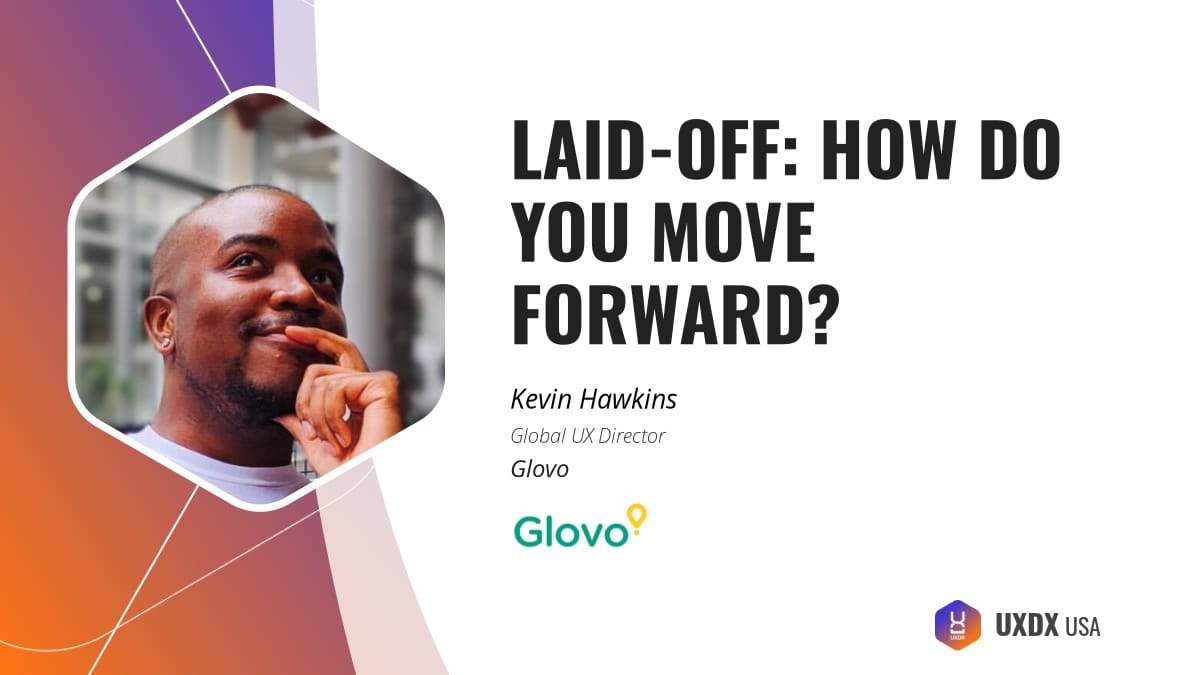
Unforunately this is a topic that a lot of people will know too well. But what do you do when all your processes are made for large teams and embedded resources and the rug is pulled from underneath you?
Kevin will share the story of forced downsizing and how they reacted at Glovo at UXDX USA this may.
VIEW AGENDA

Attend
UXDX USA | 16-18 May 2023
UXDX EMEA | 11-13 Oct 2023
UXDX APAC | 14-16 Nov 2023
Free to Attend
Functional Programming and Aligning Stakeholders | 8 Feb
Bridge the Digital Gap and Reconsider Classical Learnings | 9 Feb
Speak
Do you have a great case study that highlights how you have adopted a new practice, tool or technique?
Do you want to share the challenges as well as the successes?
Hiring
Looking to recruit the best talent? Post your open role and build your dream team.
Post your open roles for free now!

Seeking
Looking to grow your career?
Find a role at the companies that care about product teams.




UXDX
13A Belgrave Road, Rathmines, Dublin D06 E9H9, Ireland
You've received it because you've subscribed to our newsletter.
|