The Weekly Product Review: Bridging Team Autonomy and Product Success
Empowering teams requires trust. Stream Teams are given the autonomy to achieve the product objectives they’ve been set, and they are accountable for outcomes rather than just outputs. However, autonomy does not mean operating in isolation - effective product development requires ongoing monitoring to ensure teams are driving meaningful impact. This is where the Weekly Product Review (WPR) comes in.
The goal of a WPR is to review the performance of the product. It is not a status update meeting, but one where everyone reviews the key product and business metrics to identify variances from expectations so that quick corrective action can be taken before problems escalate.
Stream Teams are accountable for their product metrics, so they need to have clear justifications for each variance.
By keeping the focus on metrics and particularly customer usage patterns, the WPR helps maintain the customer-focused delivery of each team.
Which best describes the primary characteristic of your regular review meetings? |
This Week’s Updates
Enabling the Team
The Weekly Product Review: Bridging Team Autonomy and Product Success by Rory Madden
By maintaining a consistent cadence of metric review and improvement, teams can spot trends early, make informed decisions, and drive meaningful impact for their customers and business.
Product Leadership Archetype by Marty Cagan
Product leaders tend to fall into archetypes like the Builder, the Coach, the Operator, and the Visionary. Recognising your dominant style and its blind spots helps you build stronger teams and balance leadership across the organisation.
Product Direction
Spot The Real Blocker In Heated Product Debates by Amy Mitchell
Recurring product arguments are often symptoms of an unnamed decision. This demonstrates how to surface the real question, identify the trade-offs, and guide teams from a circular debate to a clear direction.
Beyond Individual Productivity: Rethinking AI Strategy In Product Teams by Anna Lefour
Most teams use AI as a personal speed boost without changing how designers, developers and product managers work together. Using AI as a shared infrastructure, with common tools, patterns and guardrails, improves handoffs, creates shared context and lets trios focus on better decisions.
Continuous Research
Create Case Studies For The Business Value Of “Old” Customer Research by Jake Burghardt
Experiments to push forgotten insights into product planning can shift perspectives on the value of existing research.
UX Research Isn’t Intersectional. It Barely Sees Ethnicity At All. by Leena Haque
Most research practices overlook ethnicity and intersectionality, leading to insights that miss the realities of diverse users. Expanding recruitment, methods, and analysis to include lived experience creates findings that are truer, fairer, and more actionable.
Continuous Design
How Can AI UI Capture Intent? by Sharang Sharma
As AI interfaces evolve, understanding user intent becomes more important than predicting actions. Designing for intent means creating systems that adapt to ambiguity, learn from context, and build trust through transparent feedback loops.
Should Designers Be Paid The Same As Engineers? by Andy Budd
Andy argues that salary gaps come from markets, negotiation and proven productivity, not fairness. Urges designers to stop trading pay for titles or passion and to show a sharper impact and speed if they want engineering-level compensation.
Continuous Development
Why Language Models Hallucinate by OpenAI
Hallucinations stem from how models predict text rather than verify facts, making confident mistakes inevitable without grounding. Reducing them requires better retrieval, tighter feedback loops, and designs that separate generation from validation.
Most Important Tips For System Design Interviews by Saurabh Dashora
Boils system design interviews down to 23 habits: clarify requirements, estimate capacity, and use the right scaling, storage, resilience and data patterns while narrating trade-offs out loud.
Seen an interesting article online? Share it with us, and we might feature it in our next issue!
Click here to share an article

Black Friday Is This Week - Get Up To 50% Off!
Here Is A Preview Of The First Speakers For UXDX 2026
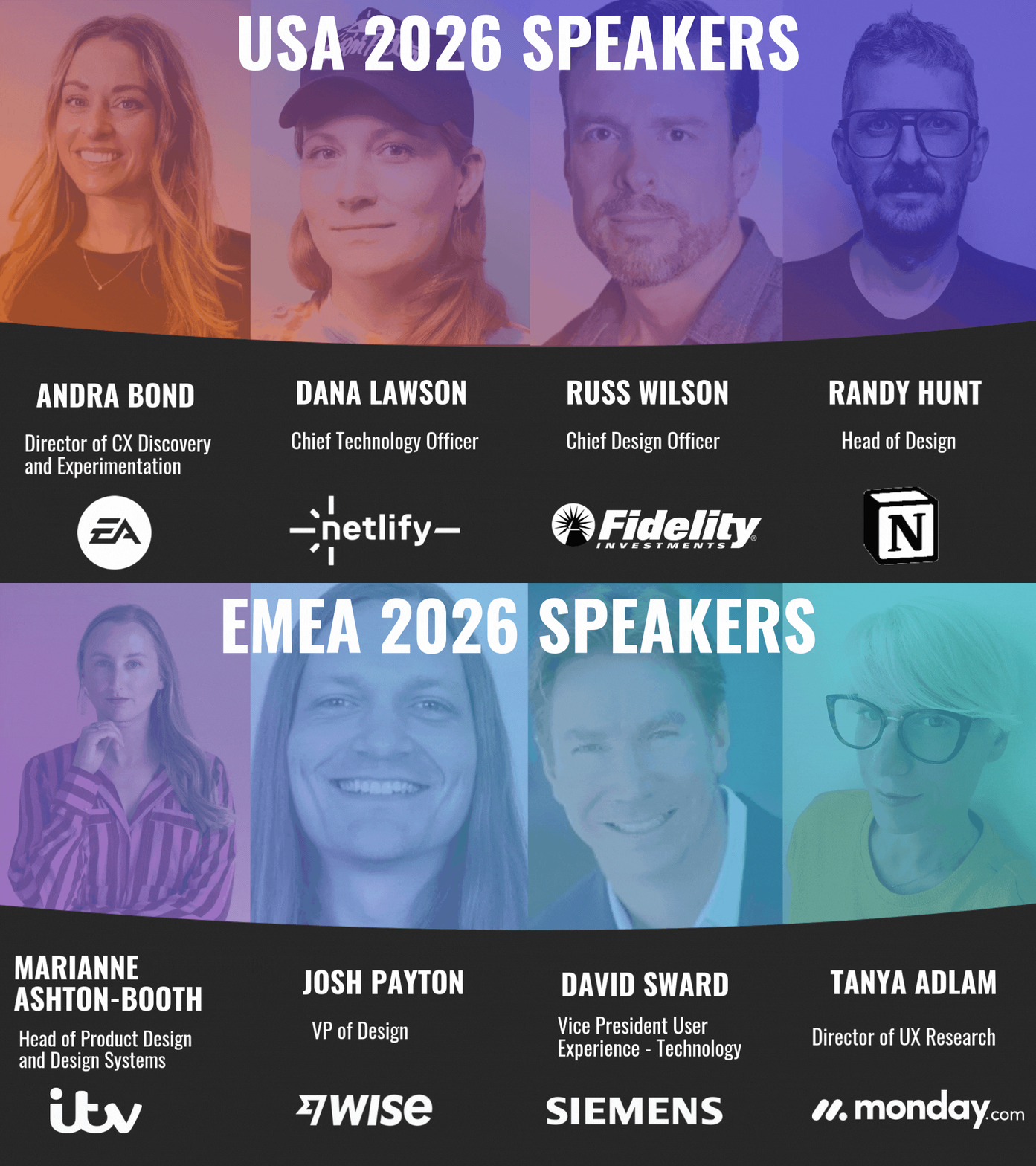
We’re giving the UXDX community an early look at the first names joining our 2026 agenda before Black Friday. Across EMEA and the USA, this first wave includes leaders shaping the future of product, engineering, research, and design.
In the USA, from EA’s Andra Bond on aligning design, research, data and operations, Fidelity’s Russ Wilson on training product managers to become designers, Netlify CTO Dana Lawson on designing for the Agent Experience (AX), and Notion’s Randy Hunt on skill-based design teams. Over in EMEA, we’re welcoming Wise’s Josh Payton, monday.com’s Tanya Adlam, Siemens’ David Sward, and ITV’s Marianne Ashton-Booth voices who are redefining how global teams build, collaborate, and deliver impact.
Black Friday is your only opportunity in the coming months to secure UXDX 2026 tickets at up to 50% off. The price drop runs from 28 November to 2 December, and it’s the lowest pricing we’ll offer before the events kick off. With more speakers being announced on Black Friday, now is the moment to get internal approvals in place and be ready. Join us in 2026 and be part of the conversations that will shape the next chapter of product, UX, design, and engineering. Book your tickets (with an extra 10% off) using the code(s) below:
UXDX USA 10% Discount: 10NEWSLETTERUSA26 | UXDX EMEA 10% Discount: 10NEWSLETTEREMEA26 |

FREE COMMUNITY EVENTS
IN-PERSON 4 Dec: Lisbon 4 Dec: Seattle 4 Dec: New York (Figma) 13 Dec: Washington, DC 🔔 Want a UXDX Community event in your city? or, alternatively, if your company wants to host an in-person event, please reply and let us know. | ONLINE Stay tuned, more online sessions coming soon! |
Video Of The Week
From Output to Outcome:
Driving Cultural Change in Product Teams
Shifting from output-driven KPIs to outcome-focused goals sounds simple on paper, but in practice, it requires a deep cultural shift. In this talk, Jay shares how Eneco transformed the way their product teams work by embracing continuous discovery, strengthening cross-functional collaboration, and placing customer value at the centre of every decision. It’s an honest look at what it really takes to move beyond feature delivery toward meaningful impact.
You’ll learn how teams can transition KPIs from outputs to outcomes, build a customer-focused culture across product, design, and engineering, and apply frameworks like Opportunity Solution Trees in the real world. If you're working to create more alignment, more learning, and more value in your organisation, this session is a must-watch.
The Results of Last Week’s Poll
The question: How do you typically react when usage data is not what you expect for a feature?
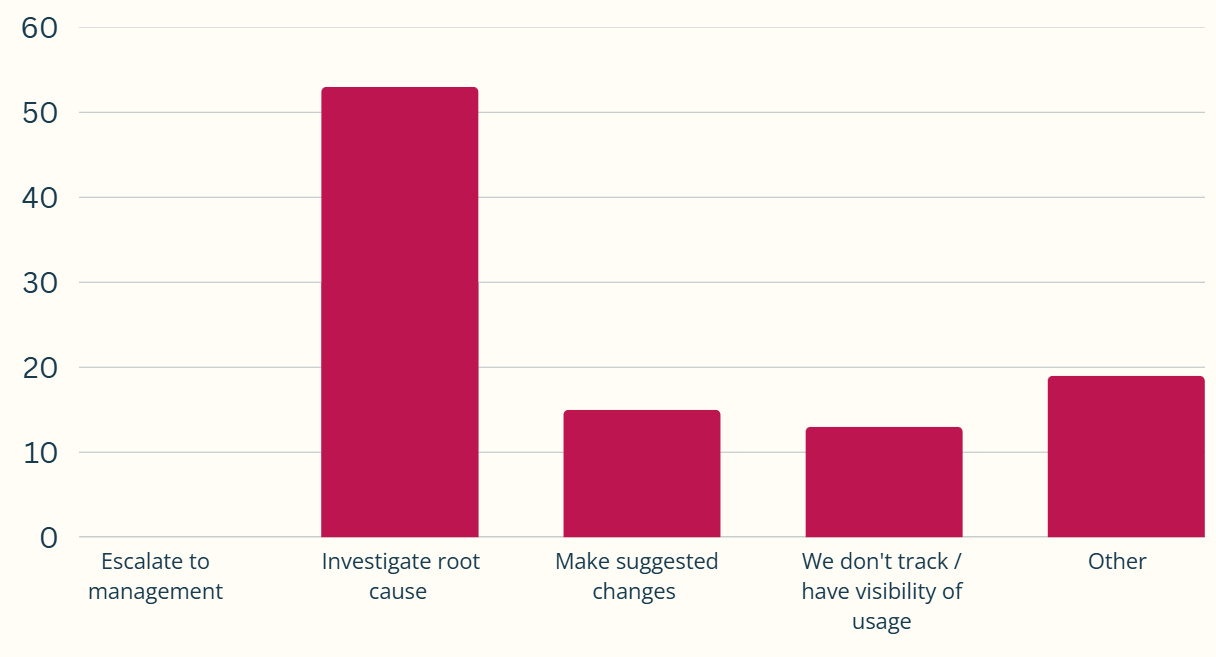
Last week’s poll asked how teams respond when feature usage doesn’t match expectations, and the results show a strong preference for learning over panic. More than half of respondents (53%) said they investigate the root cause first, which is a sign that teams are becoming more comfortable treating unexpected data as a signal, not a failure. Another 15% move straight into suggested changes, while 13% admit they lack the tracking or visibility needed to understand usage at all. Meanwhile, no one escalates directly to management, which says a lot about how teams view accountability and ownership today.
The 19% who chose “Other” often highlighted a mix of hypotheses: technical issues, unclear value proposition, misaligned messaging, or simply that users behave in unpredictable ways. The real takeaway is that organisations are maturing in how they respond to uncertainty. Rather than assigning blame, the instinct is to diagnose. And that’s exactly the mindset modern product teams need: curiosity before conclusions, evidence before action.