How To Run An Effective Quarterly Planning Session For Empowered Teams
Quarterly planning sessions can lead to an output focus. We need to ensure that we balance the needs of alignment (ensuring that teams work on the highest priority business areas) with autonomy (teams decide what to build).
To do this, Product Teams need to reiterate the vision and strategy for the product, along with the current risk appetite - do they want Stream Teams to take big bets or smaller, more conservative steps?
Planning should start with Stream Teams setting suggested targets for their streams. Product Teams should then challenge the Stream Teams to ensure that they have done the necessary upfront research and due diligence so that they have a chance of meeting their targets.
Like all processes, there are additional challenges as well. I go into more detail about them in my article below.
Do you set outcome targets or output targets in your quarterly planning? |
This Week’s Updates
Enabling the Team
How To Be A Leader When The Vibes Are Off by Jason Diller
AI hype, RTO, and layoffs have made tech feel hostile. Dive into a manager’s playbook to back company decisions in public while privately validating fears, softening rigid policies, and acting as a calm, honest buffer so their teams still feel protected.
Are Roles And Responsibilities A Thing Of The Past? by Andrew Hogan & Matt Walker
Blurred responsibilities, AI tools, and cross-functional workflows are reshaping collaboration. Leaders need clearer guardrails, expectations, and support so teams do not burn out in the grey zones.
Product Direction
How To Run An Effective Quarterly Planning Session For Empowered Teams by Rory Madden
The most effective planning processes define clear intent behind goals, encourage thoughtful trade-offs and prioritisation, and provide adequate room for learning, particularly for new teams.
Product-Centricity When You Don't Sell A Digital Product by John Cutler
Non-digital businesses cannot just copy SaaS playbooks; becoming product-centric means rethinking incentives, data, and org design so physical services, ops, and finance all pull around long-term customer outcomes, not one-off projects.
Continuous Research
Customer Interview Analysis: Where AI Helps And Hurts by Teresa Torres
AI can speed up interview synthesis, but it can also quietly erode understanding. Strong story-based interviews and human sense-making still matter the most, with AI reserved for structuring, searching, and light summarisation.
Henry Ford's Horse Problem Wasn't About Imagination by Anton Sten
The “faster horses” quote is a licence to skip research and missing the point; asking about pain, past behaviour and workarounds turns vague feature wishes into concrete problems you can actually solve.
Continuous Design
Why Taste Matters More by Carl Barenbrug
Taste gives designers the vision to decide what truly matters, aligning every detail into a coherent point of view in a world where tools and AI can copy skills but not the cultivated judgment that actually differentiates brands and careers.
Why User Self-Efficacy Matters For AI Product Success by Maria Panagiotidi
Users adopt AI when they trust themselves, not the system, so designing warm, confidence-boosting interactions matters more than showcasing intelligence if you want sustained AI feature adoption.
Continuous Development
Developer Experience At Pinterest: The Journey To Pinconsole by Ashlin Jones, Haniel Martino, Su Rong, and Viktoria Czaran
Consolidating fragmented tooling into PinConsole, a Backstage-based internal developer platform, cuts cognitive load and speeds shipping by giving engineers a single, service-centric place to deploy, debug, and manage production safely.
Agentic AI And Security by Korny Sietsma
Agentic AI’s core risk is the “lethal trifecta” of sensitive data, untrusted content, and external calls, so securing systems means sandboxing agents, splitting task,s and blocking at least one of those three in every step while keeping humans in the loop.
Seen an interesting article online? Share it with us, and we might feature it in our next issue!
Click here to share an article

Price Increase Alert
Prices Are Rising In Five Days!

With just four days to go, prices for UXDX EMEA and UXDX USA 2026 are about to increase. If you’re planning to join us in Berlin or New York next year, the current rates are the lowest price you’ll see from now on before the events take place.
Many teams use this window to lock in tickets while budgets are still open, then sort travel and planning later. Securing your place now means guaranteed access at the best rate, plus time to align internally and get real value from the experience. If UXDX is on your 2026 radar, now is the moment to act. Use the codes below to get an extra 10% off:
UXDX USA 10% Discount: 10NEWSLETTERUSA26 | UXDX EMEA 10% Discount: 10NEWSLETTEREMEA26 |

FREE COMMUNITY EVENTS
IN-PERSON 21 Jan: Copenhagen 22 Jan: Dublin 22 Jan: Los Angeles 28 Jan: Boise 🔔 Want a UXDX Community event in your city? or, alternatively, if your company wants to host an in-person event, please reply and let us know. | ONLINE |
Video Of The Week
Building AI-Driven Workflows at Airtable
Can a $200 AI prototype outperform a full engineering team? Jimmy Hillis, VP and Head of Engineering at Airtable, thinks so. And he’s got the results to prove it. During his talk at UXDX USA 2025, Jimmy revealed how his team redefined product development by playing earlier with AI tools, building prototypes in days instead of weeks, and focusing relentlessly on value over process.
From vibe coding to productionising at scale, he explores what happens when teams trade perfection for experimentation and how that mindset is transforming the way Airtable builds. Check out the full talk now on YouTube:
The Results of Last Week’s Poll
The question: Do you think your organisation would embrace real autonomy for teams to decide what to build?
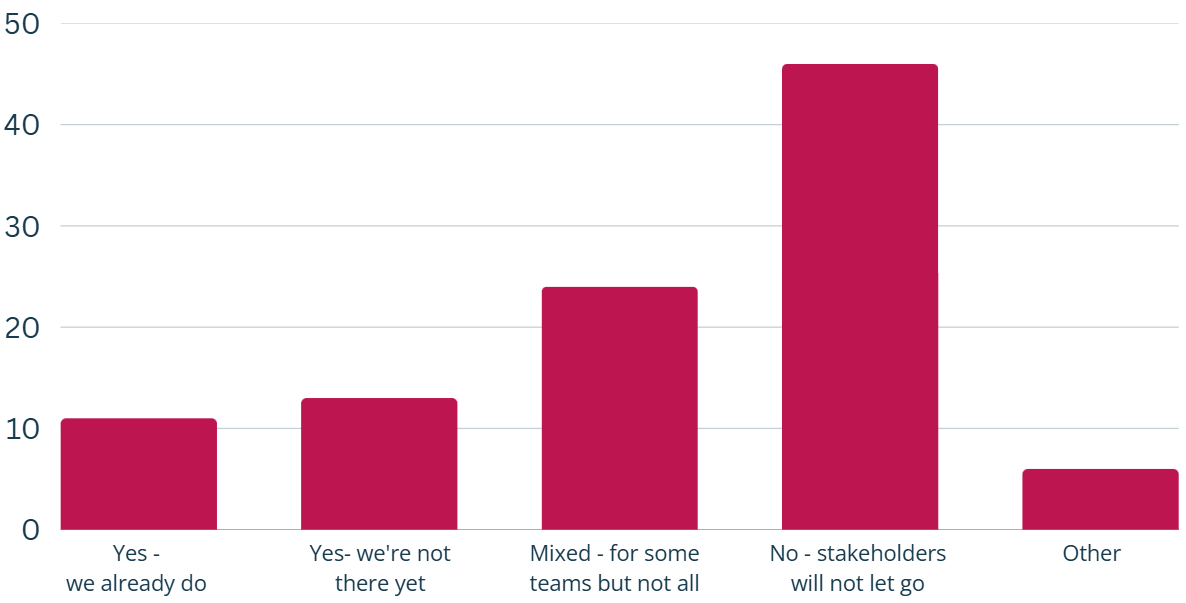
This week’s poll asked whether organisations would embrace real autonomy for teams to decide what to build, and the results are pretty blunt. Nearly half of respondents (46%) say stakeholders won’t let go. Another 24% say autonomy exists, but only for some teams. Just 11% feel they already have it, with 13% saying they’re moving in that direction.
The pattern is familiar: autonomy is often “conditional”, granted when things are calm, then pulled back the moment risk, deadlines, or scrutiny increase. If stakeholders want empowered teams, they need to stop treating autonomy as permission and start treating it as a design problem: clear outcomes, decision boundaries, and a shared cadence of evidence that makes letting go feel safe.