Team Dependencies Kill Performance
Dependencies remove autonomy, which kills accountability. Once you have handoffs, you allow people the wiggle room to throw up their hands and say, "I did my job".
Four types of dependencies silently undermine team performance:
Structural dependencies - teams rely on other teams
Governance dependencies - teams rely on sign-offs
Technical dependencies - teams share code, environments, and tools
Knowledge dependencies - centralised subject matter experts.
The usual response is to hire more managers to "manage" the dependencies, but this creates slower, more expensive delivery through an ever-growing management structure.
Instead, we need to identify and remove dependencies altogether. Check out the article below for more details on the types of dependency and how to remove them.
Which type of team dependency blocks your team most often? |
This Week’s Updates
Enabling the Team
The 4 Types Of Team Dependencies That Kill Performance (And How To Spot Them) by Rory Madden
Dependencies remove autonomy, which kills accountability. We need to identify the different types of dependencies to remove them.
How To Spot Signs Of UX Maturity Regression by Kate Kaplan
Recognizing signs of UX maturity regression early and addressing them quickly helps organizations sustain momentum and avoid backsliding.
Product Direction
What To Do When Your Manager Doesn’t Have A Strategy by Jenny Wanger
Treating your manager like a user interview and ghostwriting their draft strategy helps you pull implicit priorities out of their head, create a usable one-pager, and get the alignment you need without triggering defensiveness.
Why Most AI Products Fail (And How To Break The Cycle) by Alireza Azarparand
AI products fail less because of weak models and more because of strategic misalignment, so fixing market, problem, solution, and incentive fit - with simple MVPs, aligned KPIs, and user impact as the benchmark - matters more than chasing model accuracy.
Continuous Research
Same, But New: UX Research In The Age Of LLMs by Connor Joyce
LLMs do not replace UX research; they expand it. Defining quality rubrics, prompt instructions, and eval signals from real user needs lets researchers shape how AI features behave, not just how they look in the interface.
Insights Aren’t Outcomes: Research Recommendation Breakage by Brian Utesch and Tammi Fitzwater
Research recommendations often fail to reach users. Without tracking adoption, teams rely on hope instead of evidence to confirm their work creates change.
Continuous Design
The Psychology Behind TikTok's Addictive Feed by Dan & Louis-Xavier
This TikTok case study shows you the psychological principles that make their video feed so addictive (and how that could be made more humane).
When Execution Gets Easy, Taste Gets Harder by Anton Sten
As AI blurs the lines between design and development, the designer's role isn't disappearing. It's expanding. But only if you're willing to fill the new space.
Continuous Development
How Design Teams Are Reacting To 10x Developer Productivity From AI by Luke Wroblewski
AI coding agents push developers out ahead of design, forcing teams to either focus on post-build UX alignment, learn to ship code with agents themselves, or retreat into “it’s just faster slop” cynicism, with only the first two keeping design relevant at 10x dev velocity.
A Decade Of AI Platform At Pinterest by Pinterest Engineering
Durable ML infrastructure comes from layering shared foundations, aligning org incentives, and timing unification with real pain. So that local modeling breakthroughs compound instead of fragmenting into one-off stacks.
Seen an interesting article online? Share it with us, and we might feature it in our next issue!
Click here to share an article

Price Increase Alert!
Prices increase on 18/1, so get your approvals in now

With 2026 planning underway, this is your 5 day heads-up that UXDX EMEA and UXDX USA ticket prices go up on 18/1. If you want the lowest rate, now’s the moment to lock it in, because from that date onward it only moves in one direction.
The good news is you can plan with confidence: over 80% of the 2026 agenda is already live. If the new year has you thinking about career momentum, team capability, or the next set of tools and practices you need to stay relevant, this is a clean way to make the decision early and give yourself something to build towards.
Book your tickets using the discount codes below:
UXDX USA 10% Discount: 10NEWSLETTERUSA26 | UXDX EMEA 10% Discount: 10NEWSLETTEREMEA26 |


FREE COMMUNITY EVENTS
IN-PERSON 15 Jan: Berlin 21 Jan: Copenhagen 22 Jan: Dublin 22 Jan: Los Angeles 28 Jan: Boise 13 Feb: Oslo 🔔 Want a UXDX Community event in your city? or, alternatively, if your company wants to host an in-person event, please reply and let us know. | ONLINE 27 Jan: AI Speed, Real World Design |
Video Of The Week
From Lip-Service AI To Architecting AI-Empowered Experiences
What happens when AI stops being a checkbox and starts becoming a genuine design framework? Muriel Naim, Global VP and Head of Product Design & Research at Exiger, took the stage at UXDX USA 2025 to answer exactly that.
In one of the most practical talks of the conference, Muriel dismantles the industry’s biggest misconception that teams need to “do AI” without ever defining why. She shows how to move from hype to impact by targeting the right problems, building trust through transparency, and turning AI into a natural extension of great design rather than a bolt-on feature. This is the mindset shift every product team needs. This talk is a great source for anyone shaping the next wave of user experience. Watch the video below on YouTube:
The Results of Last Week’s Poll
The question: How does your organization currently handle team dependencies?
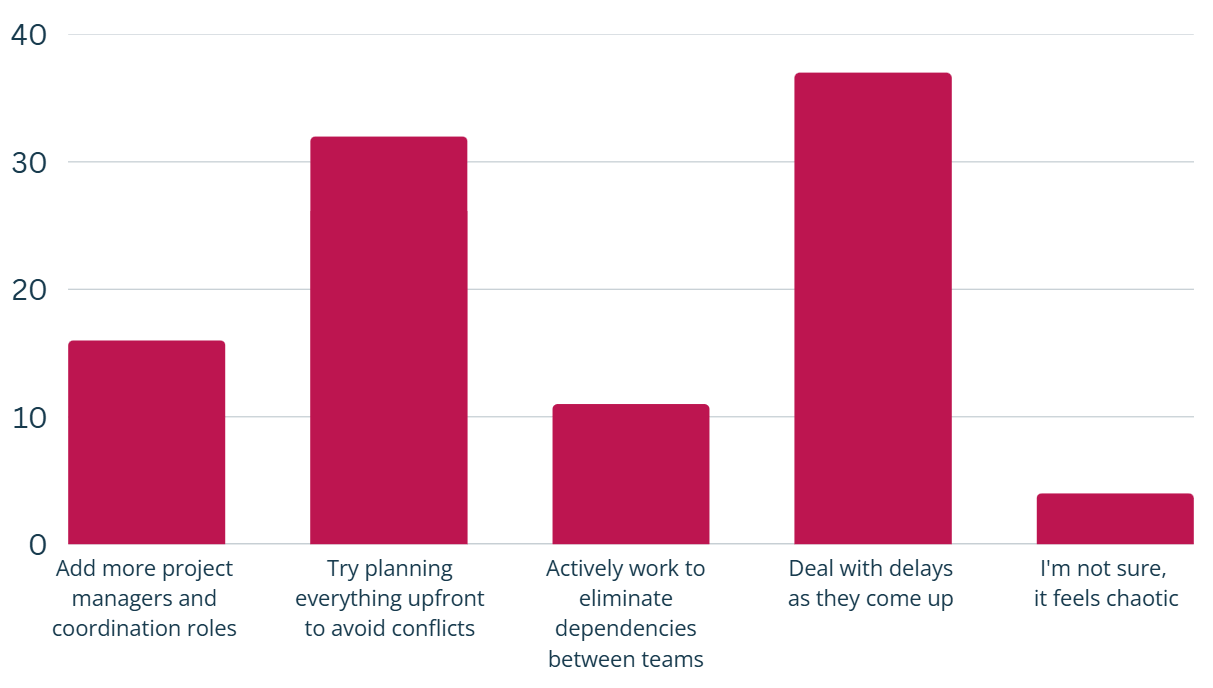
The poll of the previous week asked how organisations handle dependencies between teams, and the most common answer was also the most painful: 37% said you simply absorb the delays as they happen. Close behind, 32% try to plan everything up front to avoid conflicts, which usually signals that dependencies are predictable but still hard to remove. Only 11% said they actively work to eliminate dependencies, and 16% respond by adding more project managers and coordination roles.
The pattern is clear: most teams are managing dependency symptoms, not reducing the underlying causes. Planning harder and adding coordinators can buy short-term relief, but it often increases overhead and slows decision-making over time. The organisations that scale best treat dependencies as a design constraint: clarify ownership, cut shared components where possible, and invest in enabling platforms and standards that let teams move without waiting on each other.
If your reality looks like “plan everything” or “deal with delays,” it may be time to shift the goal from coordination to flow. Dependencies don’t disappear overnight, but you can make them smaller, rarer, and cheaper, and that’s usually where the big speed gains come from.