The Four Questions That Define Your Career Stage
AI has not just sped up delivery; it has reshaped how careers progress.
Job titles and years of experience are noisy signals now. A “senior” title can mean execution in one company and strategic judgment in another. A clearer way to understand your actual career stage is to examine the question you are answering most frequently each week.
Are you focused on getting work shipped, choosing the right solution, challenging the problem itself, or setting the direction in uncertain times? Those four questions map to four levels of thinking. And because AI is absorbing a lot of task work, the old entry-level runway is disappearing. The new baseline is judgment, not output.
This week’s article breaks down the four questions, the traps at each level, and what “levelling up” looks like in the age of AI.
Which question best describes the work you are mostly doing right now? |
This Week’s Updates
Enabling the Team
AI Has Collapsed The Career Ladder. The Four Questions That Define Your Career Stage by Rory Madden
Your career stage isn't defined by what's printed on your business card. It's defined by the question you're primarily trying to answer in your work. There are four questions you should answer to know where you are, each representing a distinct level of thinking.
Stop Making Your Team Figure Out AI On Their Own by Laura Klein
Making everyone figure out AI alone creates chaos and risk. Ops teams must step up: analyze workflows, pilot tools, and support adoption systematically.
Product Direction
8 Habits Of Highly Effective Product Leaders by Ant Murphy
Eight habits of strong product leaders: from staying a hands-on PM and treating the team as the product to coaching, radical transparency, and relentless clarity, so portfolios move forward without losing connection to the day-to-day work.
Spotify Has An AI Problem by Allan MacDonald
A flood of AI-generated “songs by no one” exposes how recommendation systems, payouts, and brand trust collide, forcing platforms like Spotify to choose between scale, authenticity and the long term viability of human-made music.
Continuous Research
Can We Still Trust Online UX Research? by Dr Maria Panagiotidi
Coherent survey answers are no longer proof of human data; protecting UX studies means tightening recruitment, verifying sources and redesigning studies so a few synthetic respondents cannot quietly skew results.
Stop Asking Users What They Want — And Start Watching What They Do by B. Prendergast
Treating user opinions as clues means prioritising observation and behavioural data, then using interviews and feature requests to explain what you see.
Continuous Design
Double Click: What Does It Mean To Be A Designer In The Age Of AI? by Andrew Hogan | Sponsored By Figma
Designers stay valuable by owning why and for whom, building technical literacy, and flexing between deep craft and generalist dot connecting instead of clinging to fixed role labels.
Are We Designing For Brain Rot? by Daley Wilhelm
Designing for infinite scroll and habit loops can quietly optimise for “brain rot” rather than wellbeing, so UX teams need to question engagement metrics, set ethical success criteria and add the right friction so products support intentional use instead of endless doomscrolling.
Continuous Development
Using LLMs At Oxide by Bryan Cantrill
Oxide is encouraging people to use models for reading, research, editing and auxiliary code. Keeping humans fully accountable for judgment, and avoiding both top down mandates and LLM shaming.
Your Team Has 15 People Now. Here's How AI Helps You Lead Them All by Gilad Naor
Using LLMs as a “leadership radar” turns scattered 1:1 notes and transcripts into living personas and prompts that surface patterns, risks and wins across a 15+ person team, so managers notice more, coach better and stay human-led instead of drowning in admin.
Seen an interesting article online? Share it with us, and we might feature it in our next issue!
Click here to share an article

Speaker Announcements and more…
Katerina Zanos & Marcus Knight are joining the stages
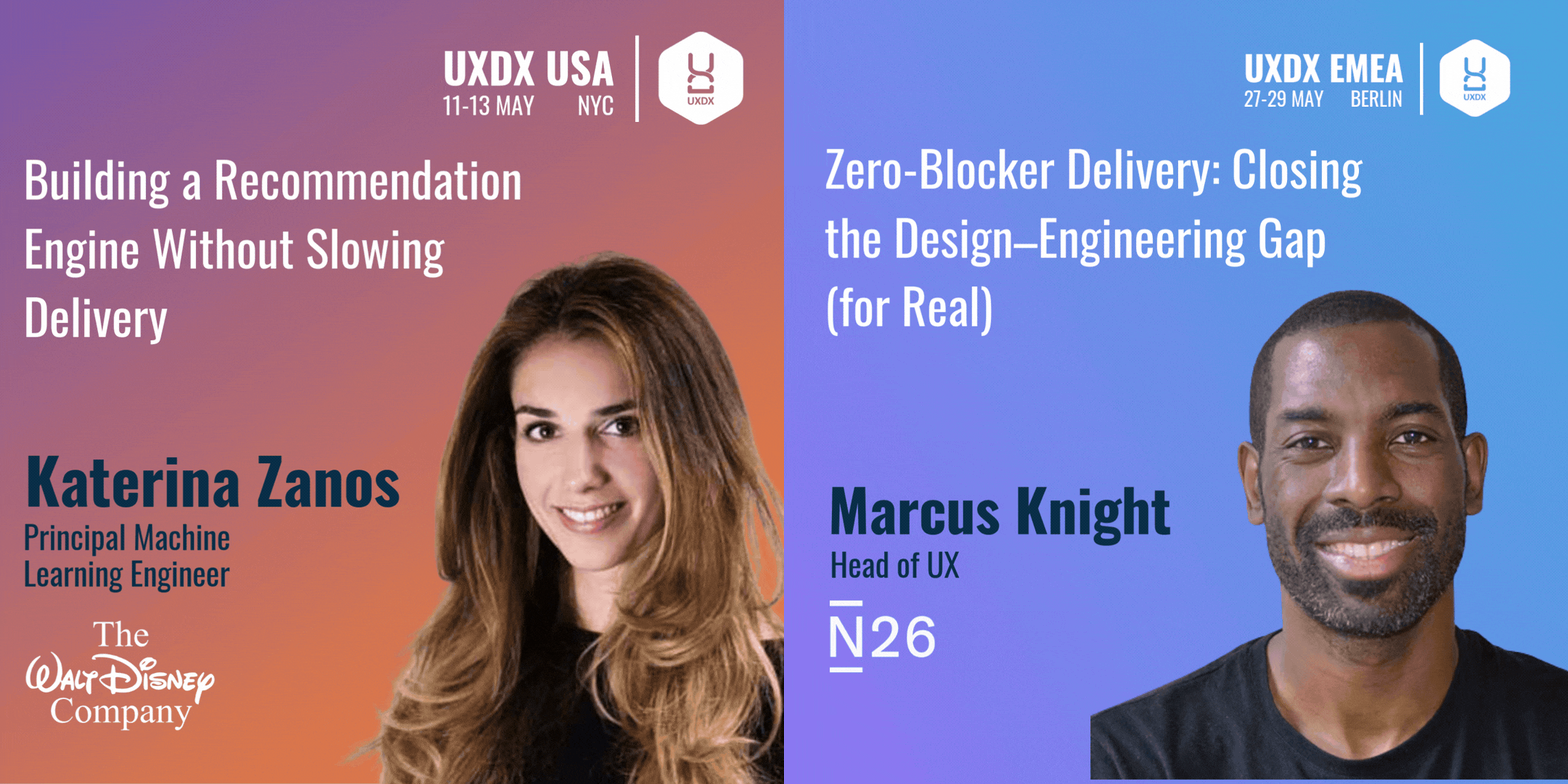
Two sessions for teams scaling design systems and AI platforms.
For UXDX EMEA 2026, Marcus Knight (Head of User Experience, N26) is joining the agenda with “Zero-Blocker Delivery: Closing the Design–Engineering Gap (for Real)”. He’ll unpack why design isn’t the bottleneck, but handoffs and uneven engineering capability often are, then share practical ways to expose friction, set pragmatic standards, and raise implementation quality without slowing velocity. He’ll also cut through the AI hype so teams invest where it genuinely saves time.
For UXDX USA 2026, Katerina Zanos (Principal Machine Learning Engineer, The Walt Disney Company) will share “Building a Recommendation Engine Without Slowing Delivery.” She’ll break down how to move from rule-based curation to ML recommendations in small, shippable steps, align around the right KPIs, and keep delivery moving while the platform matures.
Check out the events by clicking on the links below:
UXDX USA 10% Discount: 10NEWSLETTERUSA26 | UXDX EMEA 10% Discount: 10NEWSLETTEREMEA26 |

FREE COMMUNITY EVENTS
IN-PERSON Tomorrow: Boise 10 Feb: Berlin 13 Feb: Oslo 19 Feb: Glasgow 🔔 Want a UXDX Community event in your city? or, alternatively, if your company wants to host an in-person event, please reply and let us know. | ONLINE Today: AI Speed, Real World Design |
Looking for your next play? Check out these open roles by Synctera
Synctera is hiring right now, with a few senior backend roles open. If embedded finance is on your radar, it’s a solid moment to take a look here:
They’re also joining UXDX USA 2026. Ellen Linardi (Chief Product & Technology Officer, Synctera) will participate in a session called “Should Product and Engineering Sit Under One Leader?”
New Collaboration UXDX + Berlin Design
Berlin is full of amazing designers, but communities only thrive when people keep showing up for each other. That is why we are excited to share a new community partnership with Berlin Design e.V., a young association that has already grown to a strong design network in just two years.
 | Berlin DesignSince their foundation in 2023, they have built up a regional network for Design in Berlin. This non-profit organisation focuses on connecting people in the local community. |
Video Of The Week
AI in Learning and UX Design: Augmenting, Not Replacing
AI is already speeding up design work. The real question is what happens next when leaders start asking if faster means fewer people. Mike Brown, Head of Design at Barclays, makes the case for a smarter path: use AI to augment your workflow, prove the gains with data, and keep humans in the loop where risk and quality actually matter.
Mike shares how his team tested practical AI use cases in learning design, including generating high-quality assessment questions in a fraction of the time, and where the tools still fail in ways that look convincing unless you check. He also digs into the bigger bets on the horizon, from virtual coaching to personalised learning, and why regulated environments force a different mindset that most organisations would benefit from adopting. Watch the full talk now:
The Results of Last Week’s Poll
The question: What's your biggest fear about empowering teams in your organization?
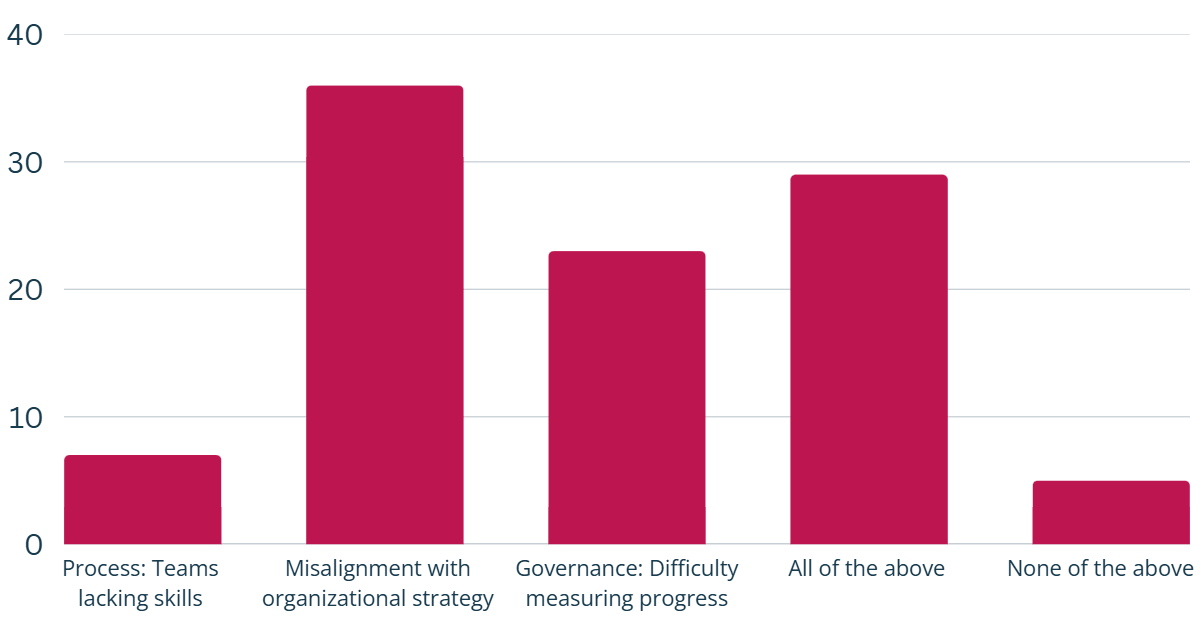
Last week’s poll asked what people fear most about empowering teams, and the biggest concern is clear: misalignment. 36% worry teams will drift away from organisational strategy, and another 29% picked “all of the above”, which tells me most leaders don’t see empowerment as one risk, they see it as a bundle of risks that compound.
The next worry is governance (23%), specifically the fear that progress becomes harder to measure once teams have real freedom. Only 7% are primarily worried about skills, which is interesting. It suggests the bigger problem isn’t capability, it’s confidence: leaders don’t trust the system to keep teams aligned, and they don’t trust the metrics to tell them early when things are going off track.
My take is that these fears are valid, but they’re usually symptoms of missing design constraints. Empowerment works when you pair autonomy with three things: clear outcomes (so teams know what “good” means), decision boundaries (so strategy doesn’t get renegotiated sprint to sprint), and a cadence of evidence (so governance becomes learning, not policing). Without those, empowerment feels like risk. With them, it becomes one of the fastest ways to scale execution without scaling bureaucracy.