AI Makes Work Easier, And Growth Harder
AI is making it radically easier to produce impressive work, but it is quietly removing the friction that used to build judgment.
The boring repetition, the dead ends, the rewrites, the debugging, the slow iteration, that was where pattern recognition came from. Over time, pattern recognition became taste. Taste became judgment. And judgment is what makes someone effective when the situation is messy and unclear.
Now we can generate outputs in minutes, but that speed can bypass the thinking that the output was meant to develop. You can look experienced on the outside while the foundations are still missing.
The shift is simple but uncomfortable: learning is no longer a side effect of doing the job. If you want to grow, you have to design your own practice. Study systems, not tasks. Ship real work and reflect on what AI got right and wrong. And seek out visible reasoning from people with stronger judgment so you can learn how they think, not just what they decided. Check out my full article below.
When you use AI to speed up your work, what do you think you lose most often? |
This Week’s Updates
Enabling the Team
AI Makes Work Easier, And Growth Harder by Rory Madden
Today, a designer can generate fifteen variations in fifteen minutes. The output is faster, and the quality is often higher. But something essential is missing: the learning that used to come from the struggle. This is the central paradox of the AI era.
Middle Managers Feel The Least Psychological Safety At Work by Jan U. Hagen and Bin Zhao
To restore learning and agility, companies must redesign accountability systems, normalize fallibility from the top, and build stronger communities of practice for the middle layer.
Product Direction
The Hidden Cost Of Shipping Too Fast by Anton Sten
Treating speed as progress without shared clarity turns shipping into rework, so pausing to align on the problem, users, and definition of progress lets teams turn raw speed into real velocity instead of months of untangling rushed decisions.
Your Product Ideas Probably Suck (That's Ok) by Ian Vanagas
Treating ideas as hypotheses, not precious visions, means listing real problems, pounding the pavement for interviews, and validating the problem, then solution, so weak product ideas die fast, and only evidence-backed ones move to build.
Continuous Research
The Algorithm Aversion Paradox by Dr Maria Panagiotidi
Algorithm aversion often masks status quo bias, so framing AI as the conventional choice and designing clear override paths matters as much as accuracy if you want people to tolerate errors and keep relying on automated decisions.
The Illusion Of Unmoderated UX Testing by Sanna Rau
Without context, probing and real engagement unmoderated testing often produces shallow, misleading data, so teams need to treat it as a complement to moderated work, not a cheaper replacement.
Continuous Design
The Art Of Vibe Design by Ivan Cernja
As AI makes execution trivial, “vibe design” shifts the bottleneck to taste, where designers win by naming references, directing iterations, and articulating how something should feel so models become production muscle for a clear human point of view.
Is Addiction The Responsibility Of UX? by Daley Wilhelm
Comparing scrolling to drinking shows how infinite feeds and habit loops can mimic addiction, so UX responsibility is less about blaming users and more about designing interventions, constraints, and off-ramps.
Continuous Development
A Scientist’s Guide To Debugging Engineers by Anton Zaides
Treating performance issues as nervous system overload rather than laziness or skill gaps lets managers “debug” engineers by spotting patterns like over responsiveness, chronic lateness and messy PRs, then changing expectations and workflows so people can do their best work without burning out.
You Need To Become A Full Stack Person by Den Delimarsky
AI tools are commoditizing single-skill roles. The future belongs to people who can think, build, and ship across the entire stack.
Seen an interesting article online? Share it with us, and we might feature it in our next issue!
Click here to share an article

VOTE NOW - For Your Favourite Session!
Which wildcard should be on stage at UXDX USA 2026?

You get to choose who takes the final speaking slot on the UXDX USA 2026 agenda.
Four standout sessions are up for the wildcard vote:
Kaitlyn Daleiden (Nordstrom) on getting ahead of the product lifecycle by aligning teams to a future vision
Benjamin Hewett (Allied Solutions) on a seven-year journey growing UX from 3 to 25 and proving measurable value
Rafael Poiatti (Amil) on what agile looks like in digital health in the Global South under real regulatory constraints
Eric Olive & Joseph Mauriello (DocuSign) on moving from siloed products to unified experiences.
You can vote on LinkedIn by clicking on your favourite here: https://www.linkedin.com/feed/update/urn:li:activity:7424082793711919104
FREE COMMUNITY EVENTS
IN-PERSON 10 Feb: Berlin 13 Feb: Oslo 18 Feb: Cleveland 19 Feb: Glasgow 28 Feb: Washington DC 🔔 Want a UXDX Community event in your city? or, alternatively, if your company wants to host an in-person event, please reply and let us know. | ONLINE |
Have you already seen that these speakers are also joining us in 2026?
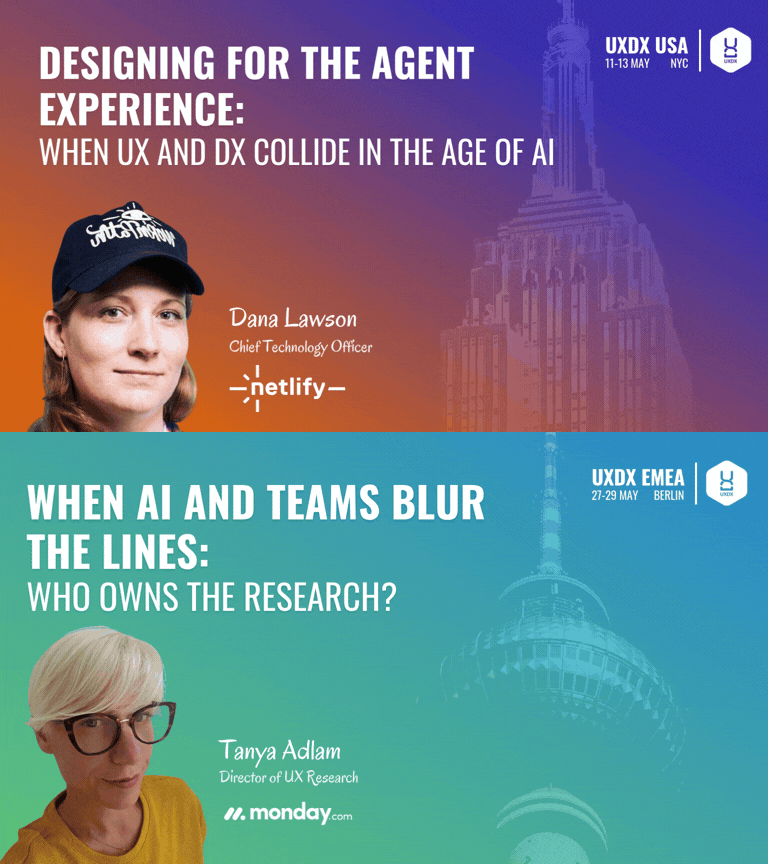
Dana Lawson, CTO at Netlify, is speaking about what might be the most provocative talk of the conference: "Are We Designing for Humans or for Agents?" As AI agents become more common, are we still designing experiences for people, or are we optimizing for bots? It's an uncomfortable question, and Dana's not going to shy away from it.
Tanya Adlam, Director of UX Research at monday.com, will share "When AI and Teams Blur the Lines: Who Owns the Research?", which addresses a question a lot of teams are quietly grappling with: when AI can generate insights, what's the role of dedicated researchers? She'll share frameworks for keeping research quality high even as the tools and team structures evolve.
Missed the announcements of other speakers? You can find the highlights of the speakers announced in January here.
UXDX USA 10% Discount: 10NEWSLETTERUSA26 | UXDX EMEA 10% Discount: 10NEWSLETTEREMEA26 |


Video Of The Week
Ways of Working in the Age of AI: From Solo Hero to Team Music
Jeff Chow (Chief Product & Technology Officer at Miro) makes a simple point that lands hard: AI is not just a productivity wave; it is a cultural opening. Most organisations are still built around tool-centred bureaucracy, constant “record scratch” moments, and processes that optimise for the middle, not the best teams.
Jeff breaks down three shifts that change the game: omnipresent knowledge, democratised craft, and faster automation. The prize is not replacing people. It is freeing teams to spend more time problem-solving together, co-creating with real “yes, and” momentum, and making decisions without freezing progress. Watch his session here:
The Results of Last Week’s Poll
The question: Which question best describes the work you are mostly doing right now?
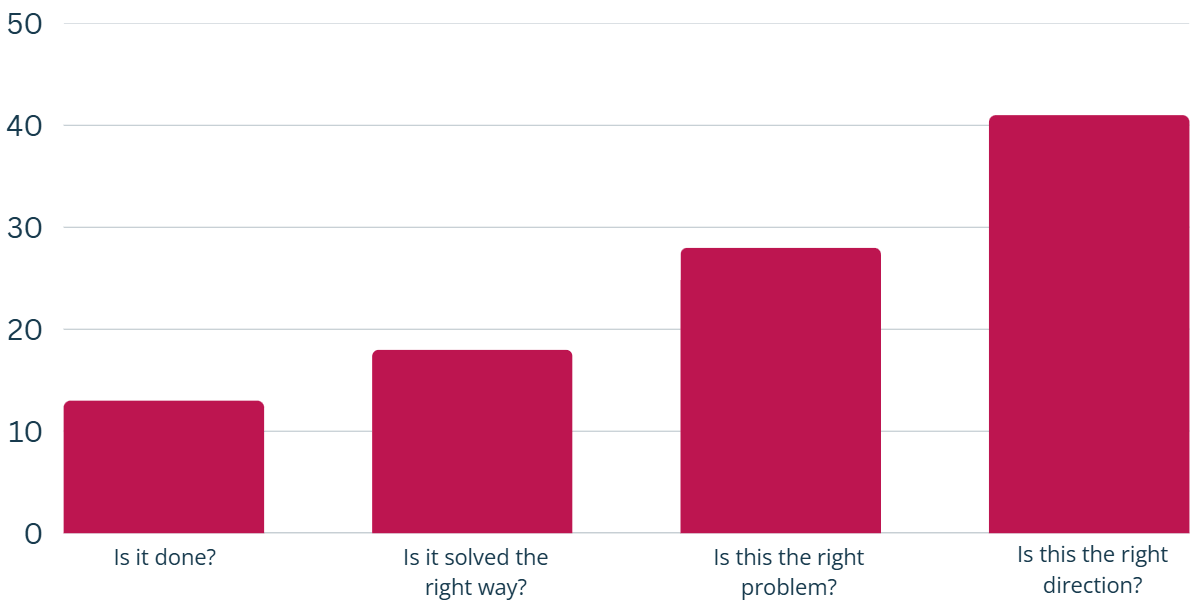
Last week’s poll asked which question best describes the work you’re mostly doing right now, and it’s a strong signal that many of you are operating at the higher levels of thinking. The biggest group (41%) is focused on “Is this the right direction?”, with another 28% on “Is this the right problem?” That means nearly 7 in 10 respondents are spending most of their energy on strategy, outcomes, and systems thinking, not just shipping.
Only 18% are mainly in solution design and trade-offs, and 13% are in pure task execution. My read is that the work is moving up the stack faster than most org design is keeping up. When people are asked to set direction and frame problems, but are still stuck with old cadences, unclear decision rights, and endless dependency management, the job starts to feel like steering with no steering wheel.
The opportunity is to match the level of thinking with the right environment. If your teams are working at problem and direction level, they need clearer outcomes, tighter constraints, and faster feedback loops, not more process. Otherwise, you end up with senior people doing senior thinking inside a system that only rewards delivery mechanics.
Want to dive deeper into levels of thinking and how it is affected by AI? Make sure to read my new ebook: Managing Your Career In The Age Of AI.