The Pyramid Is Collapsing: How AI Is Reshaping Workforce Structure
The old workforce pyramid was built on a simple trade: junior hires did high-volume execution, and in return, they got repetition, proximity, and time to develop judgment. AI is removing the economic need for that base, and with it, the default training path most organisations relied on.
As execution gets automated, the shape shifts from pyramid to diamond. Fewer entry roles. A bigger middle of people who can diagnose, coordinate, and direct work across humans and AI. The problem is that the diamond breaks the pipeline that created that middle in the first place.
This creates three risks at once. An entry crisis, where candidates need judgment to get hired but cannot get the reps to build it. A capability gap, where titles and tenure no longer match the level of thinking people can operate at. And a missing middle, where organisations may struggle to produce the next generation of leaders because the learning-by-osmosis model has been severed.
The point is not just “people should adapt.” Organisations need new entry paths, clearer capability assessment, deliberate cross-functional development, and better ways to transfer judgment, not just decisions. Otherwise, they will end up with powerful AI, and not enough people who can direct it responsibly.
Which risk feels most urgent in your organisation as AI reduces execution work? |
This Week’s Updates
Enabling the Team
The Pyramid Is Collapsing: How AI Is Reshaping Workforce Structure by Rory Madden
Entry-level hires did the grunt work, writing tickets, processing data, creating basic designs, conducting routine research, while slowly building the judgment that would carry them upward. That structure is collapsing.
How To Make A Seemingly Impossible Leadership Decision by Daisy Auger-Domínguez
There are four guidelines leaders can apply when making high-stakes decisions: 1) Map the tradeoffs, 2) pressure-test the plan, 3) use principles to guide decisions, not just policies, and 4) name the change.
Product Direction
Strategic Portfolio Management Meets Product-centricity by John Cutler
Treating strategic portfolio management as leadership’s job, not a reporting layer, means accepting that bets in software are illiquid and teams are not fungible.
The Why Always Comes First by Tobias van Schneider
Starting from a clear WHY and a small set of hard principles lets teams bake privacy, calm UX, and no-engagement-hacking into every decision, so AI and growth tactics amplify a coherent product philosophy instead of eroding it over time.
Continuous Research
The Ugly Truth About Net Promoter Score Surveys by Dan & Louis-Xavier
Poorly timed, generic NPS popups annoy users and skew results, arguing for fewer, better-targeted surveys with context and follow-up so feedback becomes a real source of insight rather than a vanity metric.
AI-Moderated Interviews: If, When, And How To Use Them by Maria Rosala
AI interviews offer faster feedback at scale, but they're not a replacement for in-depth, human-led semistructured interviews.
Continuous Design
Invisible Users: The People Our Design Processes Forget by Dolphia
How design teams systematically exclude 1.3 billion people by treating marginalized users as “edge cases”.
The AI Era Needs Sigma (σ) Shaped Designers (Not T Or Π) by Darren Yeo
Sigma-shaped designers treat their craft as system-level synthesis, orchestrating data, ethics, product, and engineering loops so AI features align with outcomes and constraints instead of just adding another spike of specialist skill to the team.
Continuous Development
Good Enough Is A Strategy by Trevor I. Lasn
Treating “good enough” as a deliberate strategy means taking on intentional tech debt to ship working, safe code fast, learn from real users, and refactor once there is traction instead of disappearing into perfect architectures nobody ever uses.
The Rosetta Stone Of Design Engineering by Yann-Edern Gillet
A deeper look at how design and engineering meet, overlap, and translate meaning. A shared language of making is the only way to build real shipping velocity.
Seen an interesting article online? Share it with us, and we might feature it in our next issue!
Click here to share an article

Wildcard Winner: Benjamin Hewett
New UXDX USA 2026 Speaker Joins The Stage
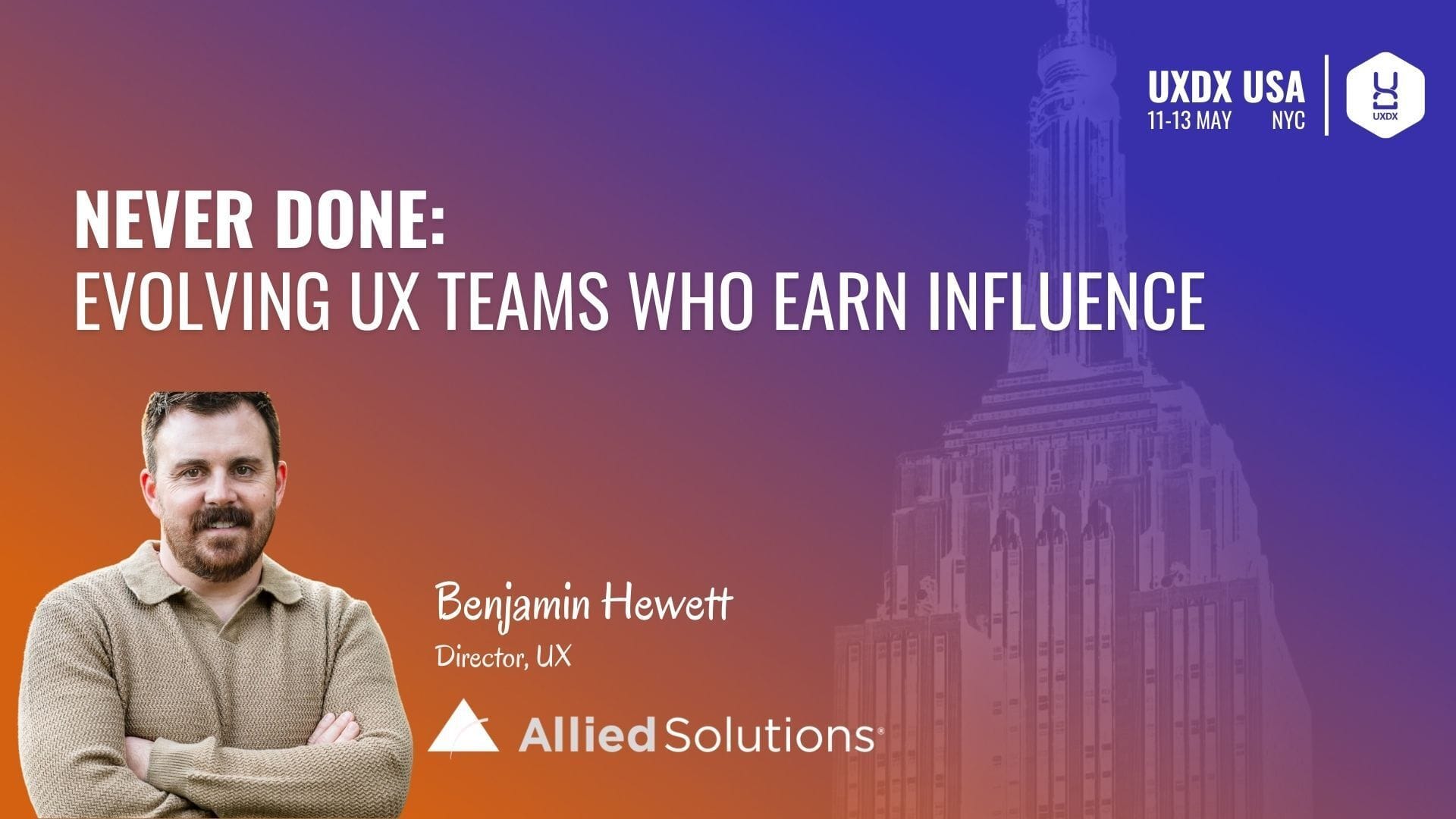
Benjamin Hewett is taking the final wildcard slot for UXDX USA 2026. Benjamin is Director of UX at Allied Solutions, and he’ll be speaking on “Never Done: Evolving UX teams who earn influence.” It’s a session for anyone who’s realised that building a design team isn’t a one-time org chart exercise, it’s an ongoing design problem.
Benjamin’s angle is refreshingly honest: high-performing UX teams don’t get there by accident, and they don’t stay there by pretending they’ve “arrived.” He’ll share what it looks like when teams design how they evolve, earn trust in the moments that matter, and grow influence in the messy reality of real organisations.
FREE COMMUNITY EVENTS
IN-PERSON Today: Berlin (SOLD OUT) Today: Boise 13 Feb: Oslo 18 Feb: Cleveland 19 Feb: Glasgow 28 Feb: Washington DC 🔔 Want a UXDX Community event in your city? or, alternatively, if your company wants to host an in-person event, please reply and let us know. | ONLINE 25 Feb: Empowering Product Design Teams |
UXDX 2026 Speaker Announcements
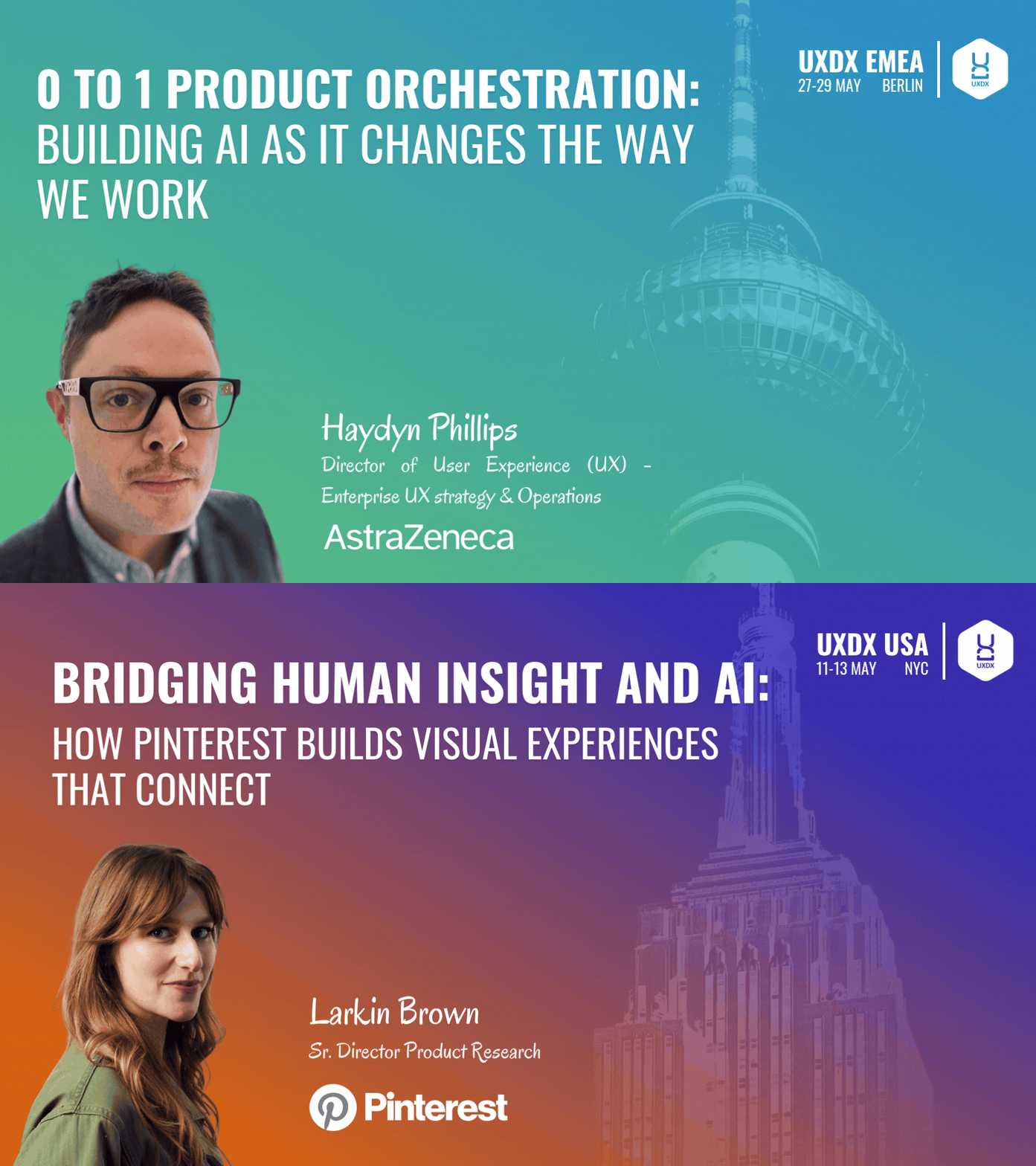
Larkin Brown (Sr. Director, Product Research at Pinterest) is joining the UXDX USA 2026 to share how Pinterest keeps real user insight at the centre while shipping GenAI features. Expect a very practical look at how research signals get translated into design decisions and then into engineering execution across Visual Search and the Pinterest Assistant, including the workflow patterns that held up and the moments that forced ethical and quality course-corrections.
For UXDX EMEA 2026, Haydyn Phillips (Director of User Experience at AstraZeneca) will unpack what it takes to build an AI product when the ground shifts mid-flight. It’s a true 0 to 1 case study: aligning research, design, analytics, and engineering around a shared AI context, keeping delivery moving while models and tooling evolve, and measuring impact through trust, quality, and adoption rather than productivity theatre.
Missed the announcements of other speakers? You can find the highlights of the speakers announced in January here.
UXDX USA 10% Discount: 10NEWSLETTERUSA26 | UXDX EMEA 10% Discount: 10NEWSLETTEREMEA26 |


Video Of The Week
The Holistic Product Journey:
Redefining Design’s Role in Cross-Functional Teams
Christina Goldschmidt shares a practical playbook for design leaders who want to be more strategic without waiting for permission. Her core idea is simple: most teams are not short on talent; they are stuck. The fastest way to unstick them is to make the future tangible enough that everyone can align.
In this talk, Christina breaks down how she earned trust inside Warner Music Group through visible delivery first, then used that momentum to shape direction across the product journey. She shows how prototypes, sizzle reels, and low-fidelity artefacts can collapse weeks of miscommunication, build cross-functional buy-in, and turn strategy into something teams can actually execute:
The Results of Last Week’s Poll
The question: When you use AI to speed up your work, what do you think you lose most often?
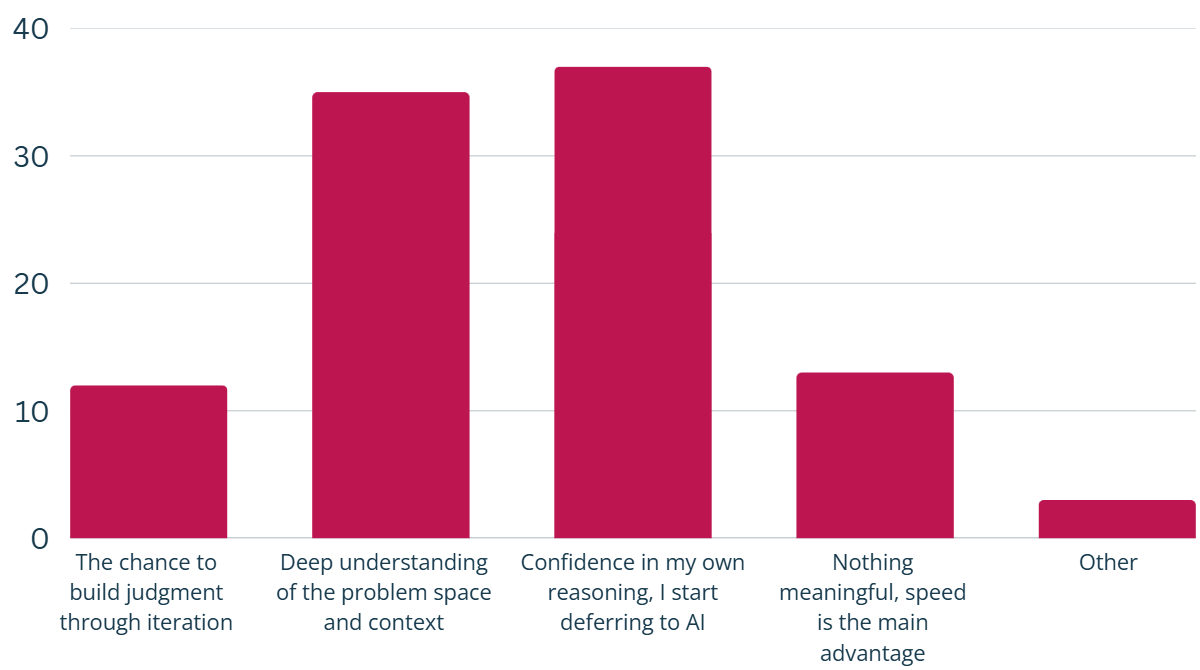
Last week’s poll asked what people feel they lose when they use AI to speed up their work, and the results are a pretty sharp warning label. The two biggest answers were confidence in your own reasoning (37%) and deep understanding of the problem space and context (35%). That’s 72% saying the cost isn’t quality or speed, it’s cognition: you move faster, but you feel less certain about why you’re doing what you’re doing, and you’re less grounded in the reality of the problem.
Only 12% pointed to the loss of iteration as the main issue, which is interesting because it suggests the bigger risk isn’t craft reps, it’s sensemaking. If you skip the slow work of building a mental model, it becomes easy to accept a plausible answer instead of earning conviction. And once you start deferring to AI, you can end up shipping “clean” work that isn’t deeply understood, which is exactly how teams accumulate product, design, and technical debt without realizing it.
The best teams I’m seeing treat AI like an accelerator, not a substitute for judgment. They use it to widen the search space, but they still insist on human ownership of the frame: what we’re solving, what constraints matter, and what evidence would change our minds. If you want to go deeper on how careers are shifting as AI compresses the ladder, my ebook Managing Your Career In The Age Of AI digs into the levels of thinking and how to keep building judgment in a world that keeps trying to automate it.