The Risk Of NOT Empowering Teams
When products fail to deliver expected business value, most organisations respond by tightening control through more detailed business cases, approval layers, and coordinators.
This approach ignores two fundamental market realities:
We don't fully understand what customers want, and
We cannot effectively manage dependencies at scale.
We are experts, so we think customers will love our ideas - but the data says otherwise. And as the company grows larger, and development speeds slow down, we introduce new coordination roles - project managers, program managers, scrum masters.
But our fixes only make the problems worse. We cannot manage our way out of exponentially increasing dependencies. Organizations caught in this cycle face declining product performance as features fall short with customers. Market share erodes as more agile competitors respond faster to customer needs, while development costs spiral upward.
Empowered teams offer a better approach because they acknowledge the reality of modern software development. They solve the uncertainty problem through outcome focus, short cycles, and iteration. And they solve the dependency problem through intentional dependency removal instead of management.
How does your organization typically respond when product features fail to deliver expected results? |
This Week’s Updates
Enabling the Team
The Risk Of NOT Empowering Teams by Rory Madden
Empowering teams is risky, but that doesn't mean that you should abandon the effort because the risk of not empowering teams is worse!
Why Labeling Relationships Is So Important by John Cutler
Labeling the relationships between goals, initiatives, teams, and data turns messy org charts into real operating maps, surfacing hidden assumptions so leaders can design strategy, portfolios, and learning loops that match how work actually happens.
Product Direction
Prototypes VS Products by Marty Cagan
Drawing a hard line between “build to learn” prototypes and “build to earn” products stops teams confusing happy path AI demos with shippable systems, forcing clearer conversations about scope, engineering demands and when something is genuinely ready to run a real business on.
Four Product Discovery Models: A Practical Map by Itamar Gilad
A clear map of the four ways companies decide what to build. Why command-and-control isn't the best and how to avoid gradual drift.
Continuous Research
The Complete Guide To Research Incentives | Great Question by Ned Dwyer (Sponsored Content)
Learn what to pay research participants, from consumer rates to executive interviews. Includes compliance frameworks, non-monetary incentives, and operational best practices.
AI Agent Ideas In Research Knowledge Management by Jake Burghardt
Designing specialised agents for alignment, ingestion, connection, reporting, and “gardening” turns research repositories into active systems that push relevant insights into roadmaps and docs instead of leaving past studies to rot in a passive database.
Continuous Design
Human Engineering by Michael Parent
Human engineering treats design as shaping systems so it is easy to do the right thing and hard to do the wrong thing, using affordances, constraints, and feedback loops to align human behaviour with safe, effective outcomes in everyday interactions.
Stop Craft Negging by Catt Small
“Craft negging” is vague, vibe-based criticism of visual design. This kills confidence and burns out systems-minded designers, so leaders need to name expectations, invest in visual upskilling, and reward strengths instead of weaponising taste.
Continuous Development
Are Developers Slowed Down By AI? by Cat Hicks
Picking apart a hyped “RCT” on AI coding tools shows how tiny samples, messy task design, and loose AI usage make strong slowdown claims shaky, and argues that measuring developer productivity with AI needs better methods, clearer definition,s and more humility about what current studies actually prove.
You Can’t Debug A System By Blaming A Person by Busra Koken
Blameless doesn’t mean pretending. Engineering teams can move beyond blame, debug their socio-technical systems more honestly, and turn incident reviews into real learning spaces to build better systems.
Seen an interesting article online? Share it with us, and we might feature it in our next issue!
Click here to share an article

Prices increase this week!
Get your tickets now before prices increase on Sunday

Prices for UXDX USA 2026 (New York) and UXDX EMEA 2026 (Berlin) go up in 4 days, and once they rise, they won’t come back down. If you’re planning your 2026 learning and travel now, this is the moment to lock in the current rate before the next tier kicks in.
With the agenda already live, you can plan properly now: pick the sessions that matter, align it to your team’s priorities, and get the ticket sorted while the current rate is still available. If you want the best price, grab your ticket now while it’s still on the current tier. Click below to secure your tickets:
UXDX USA 10% Discount: 10NEWSLETTERUSA26 | UXDX EMEA 10% Discount: 10NEWSLETTEREMEA26 |


FREE COMMUNITY EVENTS
IN-PERSON 18 Feb: Cleveland 19 Feb: Glasgow 28 Feb: Washington DC 🔔 Want a UXDX Community event in your city? or, alternatively, if your company wants to host an in-person event, please reply and let us know. | ONLINE 25 Feb: Empowering Product Design Teams |
UXDX 2026 Speaker Announcements
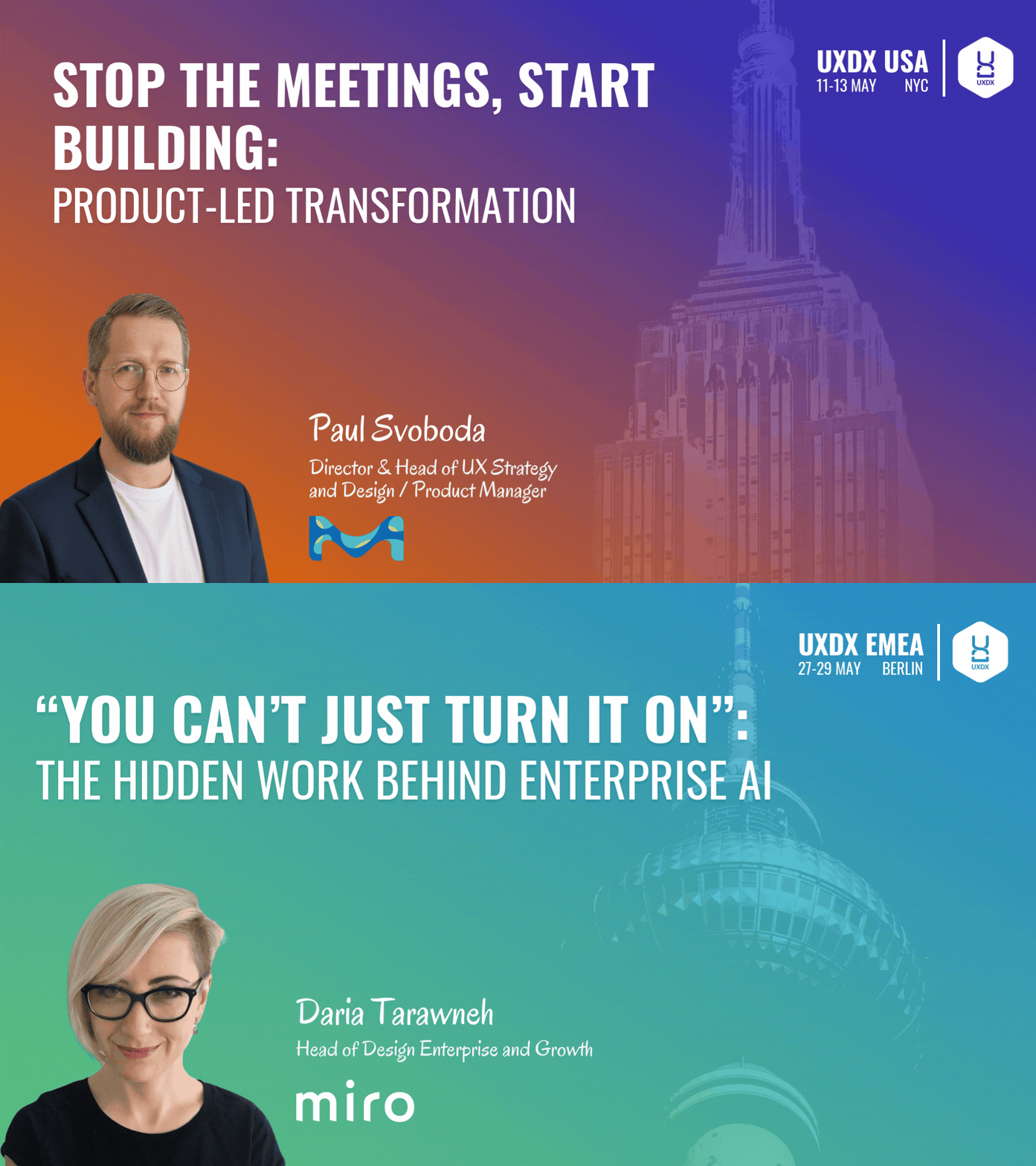
Daria Tarawneh (Head of Design Enterprise & Growth at Miro) is joining UXDX EMEA 2026 to share the unglamorous truth about enterprise AI: the work that determines whether anything ships. If your AI roadmap keeps stalling in compliance, legal reviews, or security gates, Daria will break down how to build the right foundations and keep product, design, and legal moving in sync without turning delivery into a waiting game.
For UXDX USA 2026, Paul Svoboda (Director & Head of User Experience Strategy and Design / Product Manager at EMD Digital) will tackle transformation fatigue from a product angle. Instead of more meetings and top-down mandates, he’ll show how workflow tools can bake better ways of working into the day-to-day, then how AI can gradually make those systems smarter so change scales through behaviour, not slide decks.
Missed the announcements of other speakers? You can find the highlights of the speakers announced in January here.
Want A Taste Of UXDX? Download The 2025 Post Show Report For Free
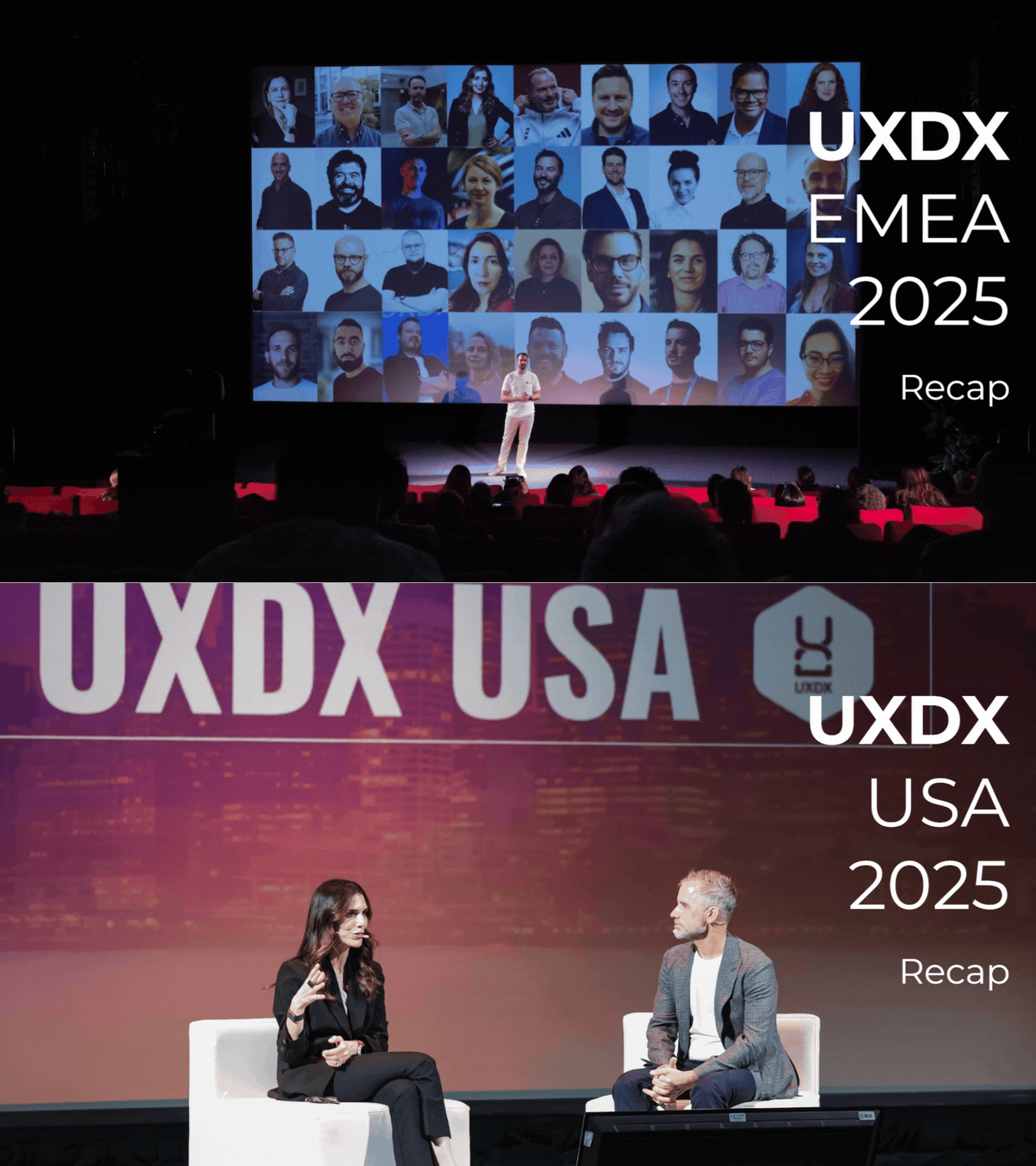
Want a feel for what UXDX is actually like before you book 2026? The 2025 Post Show Report is the clearest snapshot: what teams were wrestling with, what resonated most, and the patterns that kept coming up across product, design, engineering, and research.
2025 set the tone. But 2026 will be a different conversation as AI moves from experiments to operating model changes. Download the 2025 Post Show Report here: https://uxdx.com/post-show-report/
Video Of The Week
Navigating Enterprise Transformation:
Design and Data for Competitive Advantage
Most enterprises are trying to scale AI on top of disconnected data, manual exports, and endless deck building. In this talk, Seth Johnson (Design Program Director) and Ed Lovely (Chief Data Officer) break down how IBM is solving the real blocker first: creating a single operational truth that leaders can actually run the business on.
You will hear how IBM uses a “client zero” loop to adopt its own products internally, why Enterprise Performance Management (EPM) matters, and what changes when end-to-end workflows are integrated across marketing, sales, finance, billing, and support. The standout moment: IBM’s C suite runs operating reviews live on dashboards, drilling from top-line numbers down to invoice level, with no spreadsheets and no slides.
If you are serious about AI in a complex organisation, this is a clear blueprint for connecting data, governance, and experience design so decisions move faster and trust stops breaking in the room:
The Results of Last Week’s Poll
The question: Which risk feels most urgent in your organisation as AI reduces execution work?
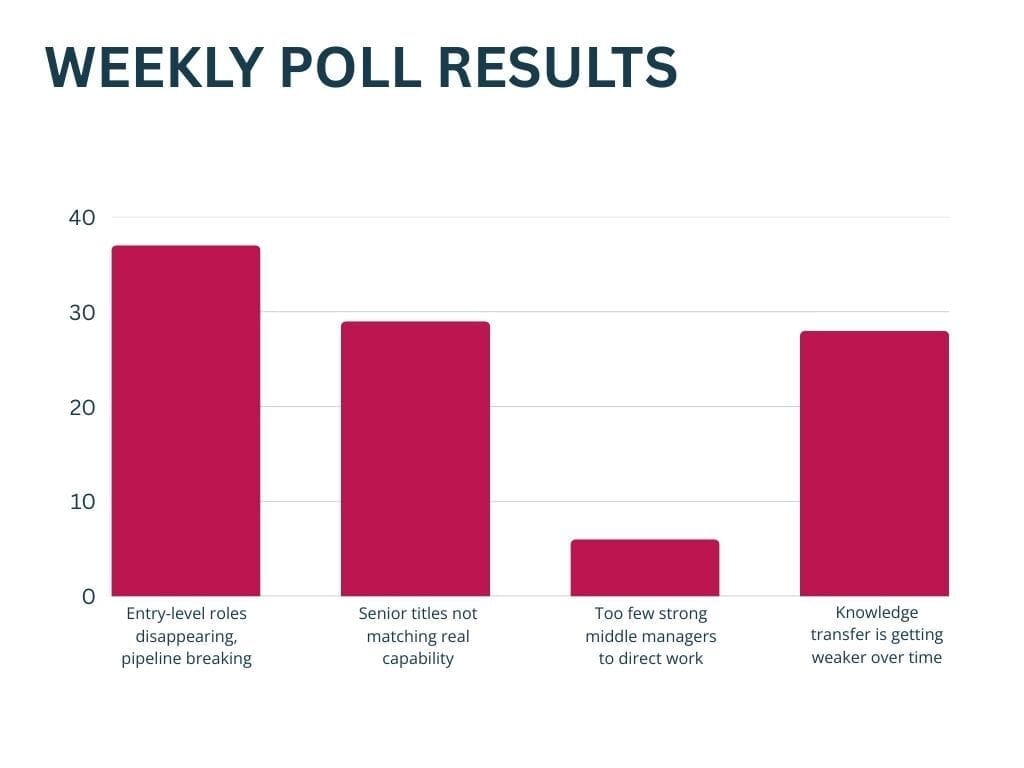
Last week’s poll asked which risk feels most urgent as AI reduces execution work, and the answers point to a career system under pressure. The biggest concern is the entry-level pipeline breaking (37%), closely followed by weaker knowledge transfer over time (28%). That combination is the real danger: fewer ways in, and fewer ways to learn once you are in.
The next signal is capability drift. 29% worry that senior titles are starting to outpace real judgment and decision quality, which is exactly what happens when output gets easier but thinking does not. Only 6% picked “too few strong middle managers,” but I read that as an outcome of the other three: if entry roles shrink and knowledge transfer weakens, you eventually feel it as a missing middle.
AI is not just changing how work gets done; it is changing how people become good at the work. If we want resilient teams, we need to design new learning loops on purpose: apprenticeships, pairing, deliberate reviews of AI output, and clearer expectations for what “good judgment” looks like at each level. Otherwise, we will ship faster while quietly eroding the capability that makes speed sustainable.
If you want to go deeper on how careers are shifting as AI compresses the ladder, my ebook Managing Your Career In The Age Of AI digs into the levels of thinking and how to keep building judgment in a world that keeps trying to automate it.