This Week’s Updates: Making AI adoption a team effort, prioritising outcomes, users in AI evaluation, 70% of Obsolete Design Skills, Accessibility and more...
From Jobs To Outcomes
With Muse, Instinct, Claude Cowork and ChatGPT Work, AI is increasingly doing the work for customers, rather than just helping them complete tasks. That raises an interesting question about Jobs to Be Done. We've often defined jobs around individual tasks, but as AI takes over more of those tasks, the opportunity shifts towards the bigger outcomes customers are trying to achieve.
At UXDX EMEA, Des Traynor predicted that software companies would increasingly move into each other's territory as traditional moats disappear. And I think we're starting to see this. Instead of solving one step in a customer's workflow, they're increasingly trying to deliver the full outcome.
What does this mean for product teams?
Software functionality alone is becoming less of a moat. We're already seeing people vibe-code software that previously took large teams years to build. But customers aren't suddenly going to build and maintain everything themselves, especially for non-core parts of their business. They'll continue to pay for products that solve real problems. The difference is that, as software becomes easier to build, the bar for what customers expect will rise rapidly, both in quality and breadth of functionality.
My advice: stay focused on uncovering real customer problems, but raise your ambitions for how completely you can solve them.
This Week’s Updates
Enabling the Team
4 Team Rituals That Drive AI Adoption by Emma Webster
Small changes to team routines can make AI adoption more collaborative. Peer learning, sharing failed experiments and prototype-first reviews offer practical ways to turn individual experimentation into team-wide improvement.
What Top Performers Do Differently with AI, and Why They See the Biggest Benefits by Christopher Stanton, Justin Shriber and Simon Rudat
AI does not automatically level performance; it often amplifies the advantage of people who already know how to structure work around it, so organisations need to rethink training, team design and operating practices.
Product Direction
Predictability vs Outcomes by Marty Cagan
The real tension in product work is predictability versus outcomes, because meaningful results require teams to admit uncertainty, test ideas and accept that many roadmap bets will fail rather than optimising for delivery promises.
The Fake Double Diamond Is Dead. The Real Double Diamond Is Immortal by Pavel Samsonov
AI can make discovery look faster and more certain without helping teams learn anything meaningful, so strong product development still depends on deliberate divergence, real evidence, explicit hypotheses and iteration.
Continuous Research
The Bronze-Silver-Gold Operating Model: How Lean Teams Can Keep Research Moving by Noémie Lozé
Lean research teams can scale without becoming a bottleneck by matching research rigor to the importance of the question, giving tactical work to trained partners, reserving researchers for strategic discovery and using clear guardrails and escalation paths to keep quality intact.
Putting the User Back into AI Evaluation by Microsoft Design, featuring Christopher Monier, Chuck Kwong and Wendy Wang
AI evals become more useful when they measure what users actually value, so researchers need to define quality from real human context, build shared taxonomies and keep the user voice inside golden datasets, multi-turn evals and ongoing model iteration.
Continuous Design
70% of Design Skills Will Be Obsolete by 2030: Here's What Will Survive by Cris Morales
As AI commoditises execution, the value of designers shifts toward judgment, taste, business understanding and the ability to ship across disciplines, making the strongest designers less dependent on handoffs and more accountable for the decisions behind what gets built.
AI-Generated UI Is Fast Design, Not UX by Sophie Shrimpton
AI can generate polished interfaces at speed, but without problem discovery, iteration and human judgment it risks producing attractive solutions to the wrong problems, so teams need to preserve the wandering, failure and craft that turn fast output into meaningful UX.
Continuous Development
How to Answer “Just Use AI and Move Faster” by Anton Zaides
When leaders push teams, engineering managers need to turn pressure into explicit trade-offs around scope, quality, and risk, then ground the conversation in real team experience rather than assuming AI removes software-delivery constraints.
Accessibility and the New Model of the Internet by Cassidy Williams
AI agents are making accessibility more valuable to software teams because the same clear structure, standards and semantics that help people navigate products also help machines understand them.
Seen an interesting article online? Share it with us, and we might feature it in our next issue! Click here to share an article
UXDX San Francisco Is Just 2 Weeks Away
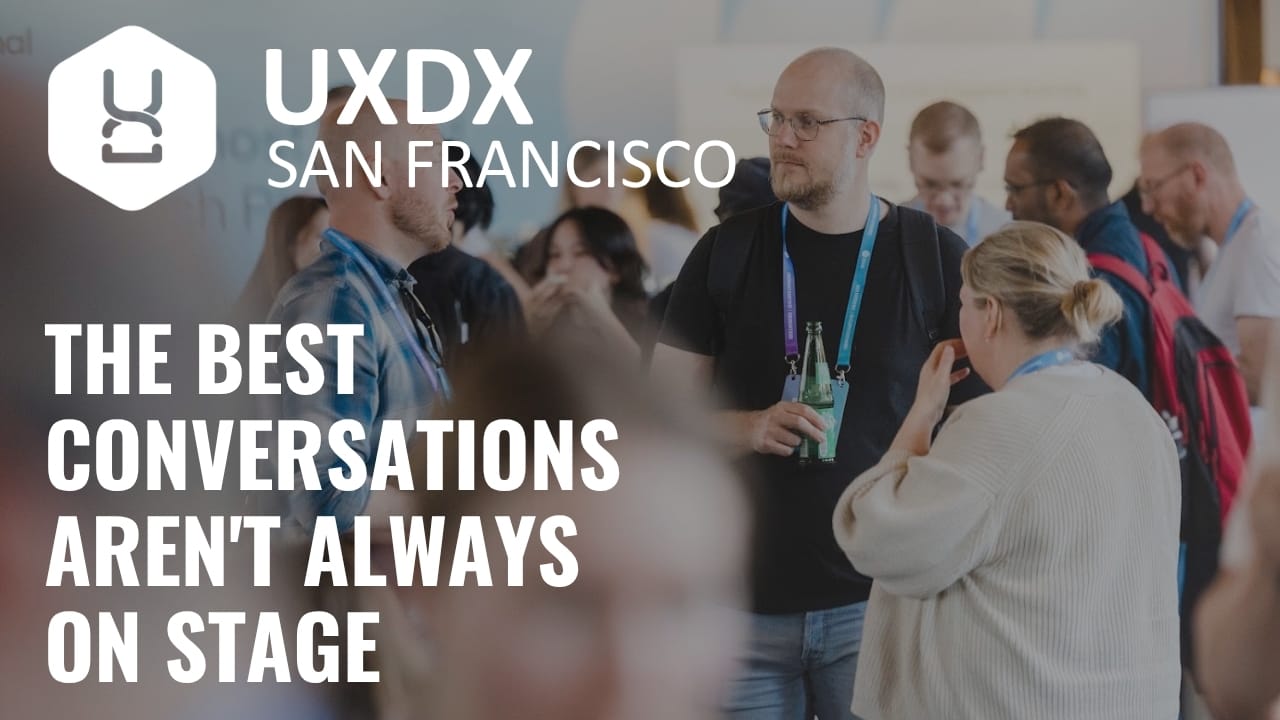
Just over two weeks until UXDX San Francisco. Some conversations you have to be there for.
You can read about AI transforming product teams, watch talks and follow the discussions online. But you can't recreate the conversations over coffee, the questions that challenge your thinking, or the unexpected connections with people facing the same problems as you.
On 5 and 6 November, product, design, research and engineering leaders will come together in San Francisco to share what is actually happening inside their organisations. Beyond the talks and workshops, it's a chance to challenge ideas, exchange experiences and learn from the people navigating these changes firsthand.
Don't just hear about the conversations afterwards. Be part of them.
Don't forget to use NEWSLETTERSF26 for 10% off tickets.
Community Events
UPCOMING IN-PERSON EVENTS
27 October: Zurich
28 October: Glasgow
UPCOMING ONLINE EVENTS
11 November: FREE WORKSHOP - Agenda Setting in Enterprise UX
Want a UXDX Community event in your city? Apply to become an ambassador
Video Of The Week
From Silos to Systems: How ITVX Turned Complexity into Cross-Functional Alignment
In this UXDX EMEA 2026 talk, Marianne Ashton-Booth, Head of Product Design and Design Systems at ITV, shares how ITVX is tackling fragmented workflows, competing priorities and inconsistent adoption across a complex streaming platform. With a small core design systems team supporting multiple products and thousands of device types, the challenge goes far beyond maintaining a component library. Marianne explains how ITVX shifted from treating its design system as a service desk to managing it as a product and an organisational operating system. She shares practical approaches to measuring system health, creating shared ownership across teams, aligning roadmaps with business priorities and building relationships that make adoption sustainable.
Watch the full session below to learn why successful design systems depend as much on people, communication and organisational alignment as they do on design consistency.
Want to go into how careers and leadership are shifting as AI compresses the ladder? My ebook Managing Your Career In The Age Of AI explores how to build judgement, relationships and influence in a world that keeps trying to automate the surface of the work.